Ever wondered how typing a few words can produce stunning images? Behind tools like CubistAI, DALL-E, and Midjourney lies a fascinating technology called diffusion models. This guide explains how they work in plain language, no PhD required.
The Magic Behind AI Images
When you type "a cat wearing a space suit on Mars" and receive a detailed image seconds later, you're witnessing diffusion models in action. But what's actually happening?
The Simple Explanation
Imagine you have a clear photograph. Now imagine slowly adding static noise—like TV snow—until the image becomes pure random dots. Diffusion models learn to do this process in reverse: starting from pure noise and gradually removing it to reveal a coherent image.
The "diffusion" name comes from physics, where it describes how particles spread out over time. In AI, we're doing the opposite—starting with spread-out randomness and organizing it into meaning.
How Diffusion Really Works
Step 1: The Forward Process (Training)
During training, the AI learns what happens when you destroy images with noise:
- Take millions of real images
- Gradually add random noise to each
- Record every step of destruction
- Create pairs: "image at step X" and "noise added at step X"
This is like teaching someone to clean by showing them exactly how messes are made, step by step.
Step 2: The Reverse Process (Generation)
When you generate an image, the AI runs backwards:
- Start with pure random noise (TV static)
- Predict what noise to remove
- Remove a small amount of predicted noise
- Repeat until a clear image emerges
Each removal step is tiny—typically 20-50 steps total—with the image becoming clearer at each stage.
Step 3: Text Guidance
Here's where prompts come in:
- Your text is converted into numbers (embeddings)
- These numbers guide the noise removal
- At each step, the AI asks: "What noise removal would make this more like [your prompt]?"
- The image gradually forms to match your description
Visual Walkthrough
From Noise to Image

Imagine generating this alien landscape. Here's what happens:
Step 0 (Pure Noise):
Random colored dots with no pattern
Step 10:
Vague shapes emerge—dark areas, light areas
Step 25:
Rough forms visible—horizon line, spherical shapes
Step 40:
Details forming—texture on spheres, sky gradients
Step 50 (Final):
Complete detailed image with all elements
Each step builds on the previous, like a photograph developing in slow motion.
Key Concepts Simplified
Latent Space
Instead of working with full images (slow and expensive), diffusion models work in "latent space"—a compressed mathematical representation.
Think of it like:
- Full image = A complete novel
- Latent space = Detailed chapter summaries
Working with summaries is faster while preserving the essential information.
The U-Net
The core of most diffusion models is a special neural network called U-Net:
- Named for its U-shaped architecture
- Takes noisy image → predicts noise to remove
- Has "skip connections" that preserve details
- Trained on billions of image examples
Denoising
The actual process of removing noise is called "denoising":
- U-Net examines the current noisy state
- Considers your text guidance
- Predicts which pixels are noise vs. image
- Removes estimated noise
- Produces slightly cleaner image
This happens dozens of times per generation.
Why Diffusion Models Excel
Advantages Over Previous Methods
Before Diffusion (GANs):
- Often unstable training
- Mode collapse (repetitive outputs)
- Difficult to control
Diffusion Models:
- Stable, reliable training
- High diversity in outputs
- Fine-grained control possible
- Better quality at high resolutions
Quality Through Iteration
Unlike previous AI that generated images in one shot, diffusion models refine progressively:
- Early steps: Major composition decisions
- Middle steps: Structure and shapes
- Late steps: Fine details and textures
This iterative approach produces more coherent, detailed results.
SDXL: The Technology Behind CubistAI
What Makes SDXL Special
Stable Diffusion XL (SDXL) is the specific diffusion model powering CubistAI. It improves on earlier versions:
Larger Model:
- More parameters for better understanding
- Trained on higher resolution images
- Better text comprehension
Dual Text Encoders:
- Two separate systems interpret your prompt
- One captures overall meaning
- One focuses on specific details
- Combined for better prompt following
Refinement Stage:
- Base model creates initial image
- Refiner model enhances details
- Two-stage process for quality
SDXL-Lightning
For faster generation, SDXL-Lightning uses "distillation":
- Train a smaller model to mimic the full SDXL
- Compress 50 steps into 4-8 steps
- Maintain most quality at fraction of time
This is why CubistAI can generate images in seconds rather than minutes.
How Your Prompt Becomes an Image
The Journey of a Prompt
Let's trace what happens when you submit a prompt to CubistAI:
1. Text Processing:
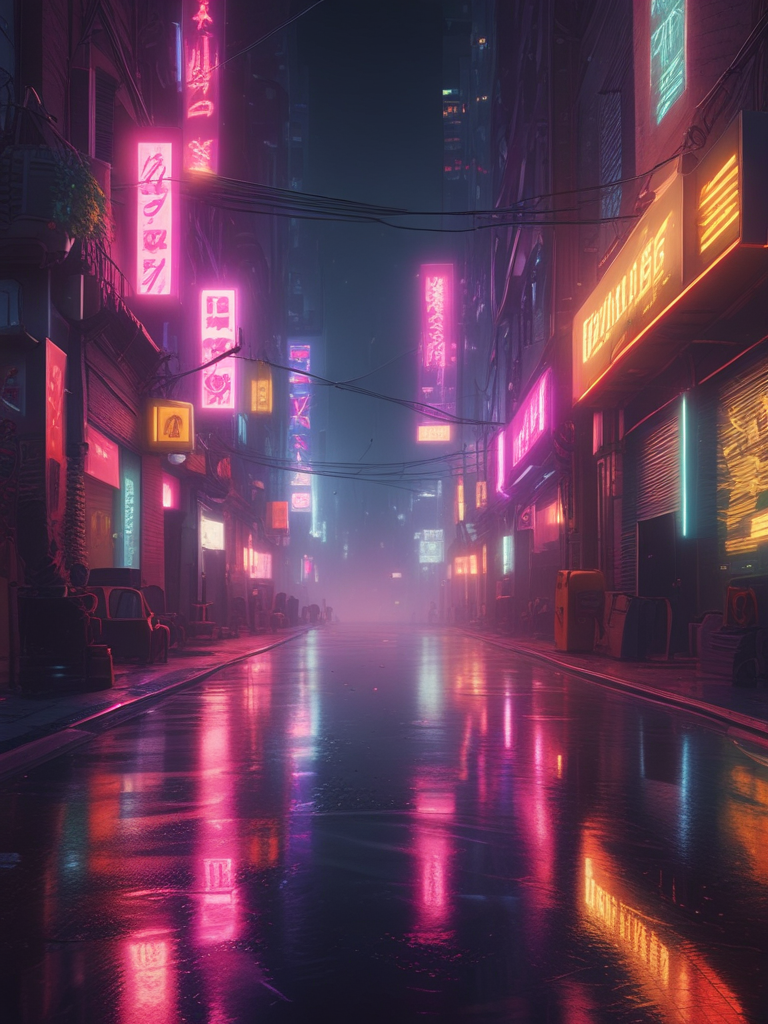
Your prompt: "cyberpunk city at night, neon lights, rain"
↓
Tokenized: [cyberpunk] [city] [at] [night] [,] [neon] [lights] [,] [rain]
↓
Embedded: Numbers representing meaning in 768 dimensions
2. Initial Setup:
Random noise generated: Pure static image
Text embeddings attached: Guidance vectors
Parameters set: Resolution, steps, etc.
3. Iterative Denoising:
Step 1: Major shapes influenced by "city" concept
Step 5: Night-time lighting develops
Step 15: Neon colors emerge
Step 25: Rain effects appear
Step 40: Fine details sharpen
Step 50: Final image complete
4. Output:
Latent space decoded back to pixels
Final image displayed to you
Parameters You Can Control
Sampling Steps
More steps generally mean better quality but slower generation:
| Steps |
Speed |
Quality |
Best For |
| 4-8 |
Very Fast |
Good |
Quick previews (Lightning) |
| 20-30 |
Moderate |
Very Good |
Standard use |
| 50+ |
Slow |
Excellent |
Maximum quality |
CFG Scale
"Classifier-Free Guidance" controls how strictly the AI follows your prompt:
- Low (1-5): More creative, may ignore prompt
- Medium (7-9): Balanced, recommended
- High (12+): Strict following, may reduce quality
Sampling Methods
Different mathematical approaches to the denoising:
- Euler: Fast, good quality
- DPM++: Balanced speed and quality
- DDIM: Deterministic results
- Ancestral variants: More random variation
The Training Behind It All
Data Requirements
Diffusion models like SDXL trained on:
- Billions of images from the internet
- Associated text captions/descriptions
- Curated for quality and diversity
- Filtered for content policies
Learning Process
- Model sees image + caption pairs
- Noise is added at random levels
- Model predicts original image from noisy version
- Wrong predictions = adjust weights
- Repeat billions of times
What the Model Learns
- Visual concepts (what things look like)
- Style patterns (artistic techniques)
- Composition rules (how elements arrange)
- Text-image relationships (what words mean visually)
Common Misconceptions
"AI Copies Existing Images"
Reality: Diffusion models don't store or retrieve images. They learn patterns and concepts, generating entirely new combinations.
Analogy: A chef who has tasted thousands of dishes doesn't copy recipes—they understand flavor principles and create new dishes.
"More Steps Always = Better"
Reality: Returns diminish after certain points. 30 steps often looks nearly identical to 100 steps.
"AI Understands Images"
Reality: These models learn statistical patterns, not meaning. They don't "understand" that a cat is an animal—they know what pixel patterns associate with the word "cat."
"Prompts Work Like Search"
Reality: You're not searching a database. Each image is generated new, mathematically derived from noise guided by your text.
Technical Deep Dive (Optional)
The Mathematics (Simplified)
The core equation diffusion models solve:
p(x_{t-1}|x_t) = N(x_{t-1}; μ_θ(x_t, t), σ_t²)
In plain terms: "What's the probability distribution of a slightly-less-noisy image, given this noisy image?"
The model learns μ_θ (the mean) through training, predicting where the signal is likely hiding in the noise.
Noise Schedules
How quickly noise is added/removed follows a "schedule":
- Linear: Constant rate
- Cosine: Slower start and end
- Custom: Optimized for specific uses
Different schedules affect generation quality and speed.
Cross-Attention
How text guides image generation:
- Image features query text embeddings
- Attention weights determine influence
- Relevant text concepts guide relevant image regions
- "Cat" guides where cat-like features appear
The Future of Diffusion
Current Developments
- Faster: Fewer steps for same quality
- Higher resolution: Native 4K and beyond
- Better control: More precise prompt following
- Multimodal: Image, video, audio, 3D
Upcoming Capabilities
- Real-time generation
- Video diffusion models
- 3D object generation
- Interactive editing with AI
Why This Matters
Understanding diffusion models helps you:
- Write better prompts: Know what influences results
- Choose settings wisely: Understand parameter effects
- Set expectations: Know capabilities and limits
- Appreciate the technology: Recognize the innovation
Try It Yourself
Experience diffusion models in action with CubistAI:
- SDXL-Lightning: See fast diffusion in 4 steps
- Standard SDXL: Compare with 30-step generation
- Parameter control: Experiment with CFG and steps
- Free to start: No technical setup needed
Conclusion
Diffusion models represent a fundamental breakthrough in AI image generation:
- Concept: Learn to reverse the process of adding noise
- Process: Gradually denoise from random to coherent
- Guidance: Text embeddings steer the generation
- Result: New images that never existed before
From random static to stunning artwork, diffusion models transform text into visual reality through elegant mathematics and massive training.
Ready to see diffusion in action? Visit CubistAI and watch your prompts transform into images through the power of diffusion models!
Learn to harness this technology better with our prompt engineering masterclass or explore SDXL-Lightning technology for the fastest generation experience.